
How to Find the HS Code for Your Export Product
Key Takeaways
- An HS code is a 6-digit number that classifies your product the same way in almost every country. The US adds 4 digits, so US exporters work with a 10-digit number.
- For exports, the official US number is the Schedule B number, issued by the Census Bureau. For imports, it is the HTS number, issued by the US International Trade Commission. The first 6 digits match.
- The fastest route is the free Census Schedule B search tool, then a check against the full Schedule B chapter text.
- Your code shows up on the EEI filing, the commercial invoice and often the Certificate of Origin, so one wrong digit can spread across every document.
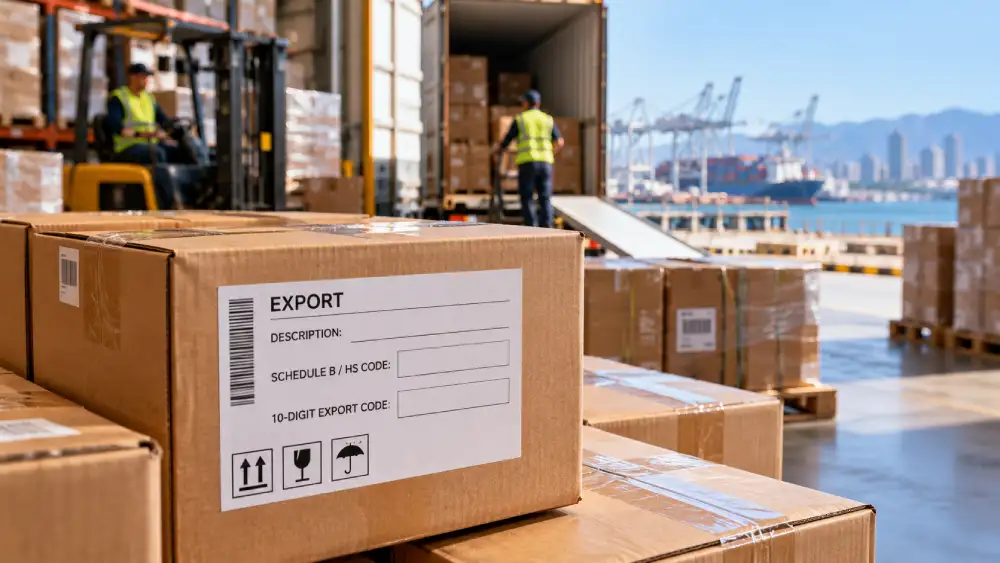
To find the HS code for your export product, start with the free Schedule B search tool from the US Census Bureau, answer its questions about what the product is made of and what it does, and confirm the result against the official Schedule B chapter. The first 6 digits are your international HS code. The full 10 digits are your US Schedule B number, which you report when you export.
That is the short answer. The longer one matters because classification is where many first-time exporters slow down. A code that looks close enough can trigger a customs hold abroad, the wrong duty rate for your buyer, or a mismatch between your invoice and your Certificate of Origin. This guide walks through how the system works, how to classify a product step by step, and how to handle the products that do not fit neatly into one box.
What Is an HS Code?
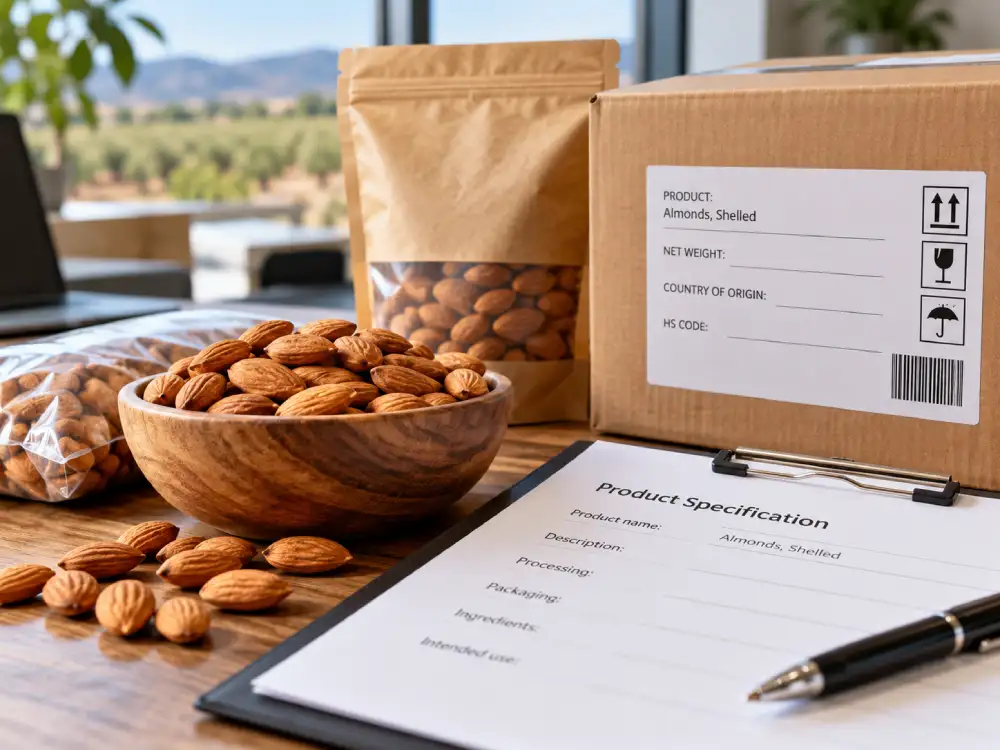
The Harmonized System (HS) is a standardized numerical method of classifying traded products, administered by the World Customs Organization and updated every five years. Customs agencies around the world use it to identify goods, apply duties and collect trade statistics.
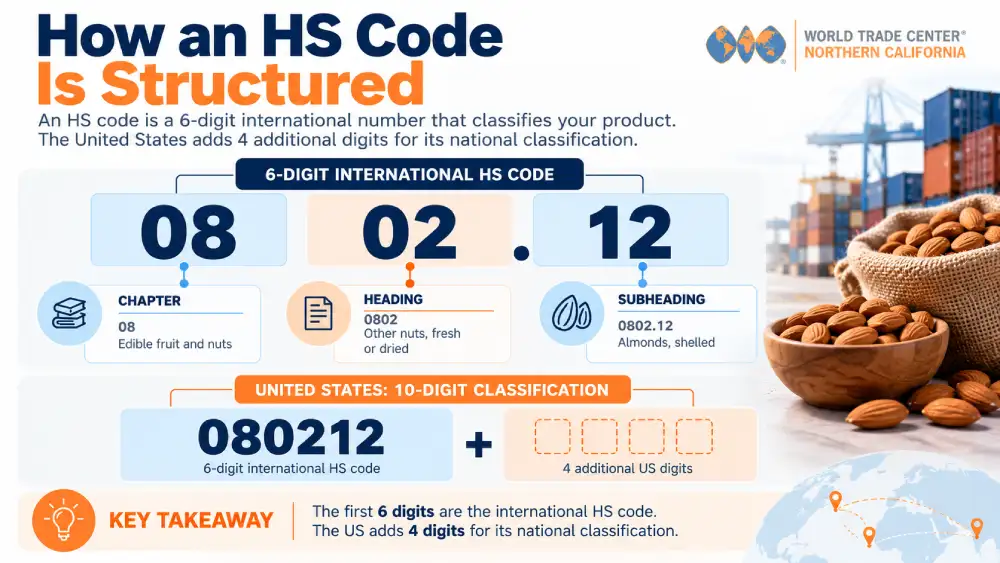
Every HS code is built in layers. The first 2 digits are the chapter, a broad product family. The next 2 digits form the heading, and the next 2 form the subheading. Read together, those 6 digits describe a product the same way in Sacramento, Seoul or São Paulo.
Here is how that works for a product many Northern California companies ship:
| Digits | Level | Meaning |
|---|---|---|
| 08 | Chapter | Edible fruit and nuts |
| 0802 | Heading | Other nuts, fresh or dried |
| 0802.12 | Subheading | Almonds, shelled |
So which one do you need? If you are exporting, the Schedule B number is the default. There is a useful exception: under the Foreign Trade Regulations, you may report the 10-digit HTS number in place of the Schedule B number in your Electronic Export Information, except where the HTS headnotes say otherwise. Companies that both import and export the same product often use the HTS number for both to keep their records consistent.
Your buyer abroad will use the first 6 digits plus their own country’s extra digits to clear the goods and calculate duty. That is why the 6-digit core has to be right, whatever list you start from.
How to Find the HS Code for Your Product, Step by Step
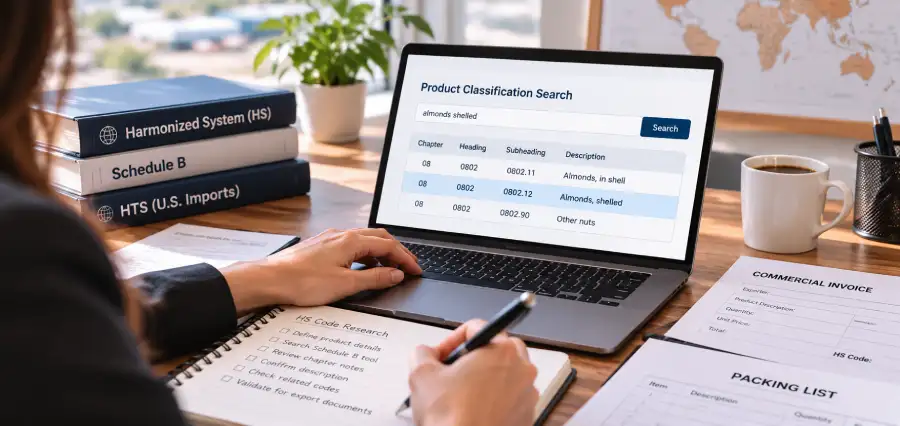
Step 1: Describe the product the way customs sees it
Customs officers classify a product by what it is, not by what you call it in your catalog. Before you search, write down four things: what the product is made of, what it does, how it is processed or assembled, and how it is packaged for sale. “Wellness bar” will get you nowhere. “Bar made of dates, almonds and cocoa, not containing chocolate coating, packed in individual wrappers” will.
Step 2: Run the Census Schedule B search tool
The Census Bureau’s Schedule B search tool is free and, as Trade.gov notes, it is the most commonly used method for classifying products. Type your description, then answer the follow-up questions about material, function and processing. The tool narrows the options and returns a 10-digit number.
Treat that result as a strong lead, not a final answer. The tool depends on the details you give it.
Step 3: Read the chapter and its notes
Open the matching chapter of the official Schedule B and read the chapter notes and the headings around your result. Chapter notes often exclude products you would expect to find there. A product can look like it belongs in one chapter and be sent to another by a single line in the notes.
If two headings seem to fit, the General Rules of Interpretation decide. As a general rule, the heading with the most specific description wins over a more general one, and a product made of several materials is classified by the material or component that gives it its essential character.
Step 4: Check binding rulings for similar products
For hard cases, search the Customs Rulings Online Search System (CROSS). CROSS holds legally binding US import rulings. They do not bind export classification, but the ITA points out that a ruling on an imported product gives you the 6-digit HS subheading, which is also the first 6 digits of your Schedule B number. From there you only need the last 4 digits from the Schedule B chapter.
Step 5: Confirm the code with your buyer and forwarder
Ask your buyer or their customs broker which code they expect to see in their country. Their extra digits will differ from yours, but the first 6 should match. If they do not, sort it out before you ship. Your freight forwarder can also confirm the number they will use in the EEI filing.
Step 6: Record it and use it the same way everywhere
Once you settle on a number, keep it in your product master file with a short note on why you chose it. Use the same code on every document for that product. Consistency is what keeps a shipment moving.
Where Your HS Code Appears on Export Documents
Your classification travels with the shipment. These are the places it shows up most often:
- Electronic Export Information (EEI). Filed in the Automated Export System (AES). Under 15 CFR 30.37, filing is generally not required when the value shipped under an individual Schedule B or HTS number is $2,500 or less, regardless of the total shipment value. That threshold is applied code by code, so correct classification also decides whether you file at all. A license requirement can make filing mandatory even below that value.
- Commercial invoice. Many importing countries expect the HS code next to each line item so their customs officers can match the goods to the declaration.
- Certificate of Origin. The code helps the certifying body and the foreign customs office confirm the product described is the product shipped. If you are new to the form, see our guide on how to fill out a Certificate of Origin.
- Shipper’s letter of instructions and packing list. Your forwarder copies the code from these into the filing, so an error here usually becomes an error everywhere.
For a full view of the paperwork, our overview of what documents you need to export from California covers each one.
Common HS Code Mistakes Exporters Make
The same errors come up again and again with new exporters.
Classifying by brand or marketing name. Customs does not know what a “glow serum” is. It knows a cosmetic preparation of a given composition.
Stopping at the search tool. The first result is often right, but the chapter notes are what make it defensible.
Using last year’s code. Schedule B changes. Census publishes lists of obsolete codes when changes take effect, typically in January and July, so a code that worked in 2025 may no longer be valid.
Classifying parts as the finished good, or the reverse. An unassembled product sold as one unit is usually classified as the finished product. Trade.gov gives the example of a boxed bicycle shipped with its frame, handlebars, pedals and seat: it is classified as a bicycle, not as separate parts. Spare parts shipped on their own are a different story.
Mixing up origin and classification. The HS code says what the product is. Country of origin says where it was made, and for trade agreements it often depends on changes in classification during production. Our post on how to determine the country of origin for your export product explains how those tariff shift rules work.
What If Your Product Is Hard to Classify?
Some products resist easy answers: kits that combine different items, new technology with no obvious heading, food blends, or products with more than one function. Start by applying the General Rules of Interpretation in order, since they were written for exactly these cases. Then look for CROSS rulings on similar goods.
If you still have two reasonable options, the Census Bureau offers classification help to exporters through the contact information on its Schedule B pages. You can also ask a licensed customs broker in the destination country, since their classification is the one that decides duty there. Keep notes on how you reached your answer. If a foreign customs office questions the code, a documented reason carries weight.
Get Your Export Documents Right with WTC Northern California
Once your HS code is settled, the rest of your paperwork goes faster. WTC Northern California certifies Certificates of Origin online, with professional compliance review before your certificate is issued. We also issue Certificates of Free Sale, GMP certificates and support apostille and legalization requests.
Apply for your Certificate of Origin online or see all of our export documentation services. If you are building an export plan from scratch, our no-cost World Trade Connect Accelerator Program walks small businesses through classification, documentation and market entry.
Frequently Asked Questions
How do I find the HS code for my product?
Use the free Census Bureau Schedule B search tool, answer its questions about what the product is made of and what it does, and confirm the result in the official Schedule B chapter. The first 6 digits of the 10-digit result are your international HS code.
Is the Schedule B number the same as the HS code?
Not exactly. The Schedule B number has 10 digits, and only the first 6 are the international HS code. The last 4 digits are added by the US for export statistics.
What is the difference between a Schedule B and an HTS code?
Schedule B is the US export classification, managed by the Census Bureau. HTS is the US import classification, managed by the US International Trade Commission. Both use the same first 6 digits, and the HTS number can usually be reported in place of Schedule B in the EEI.
Do I need an HS code to export from the US?
Yes, in most cases. You need it to file Electronic Export Information when a single code exceeds $2,500 in value or the item needs a license, and most buyers and foreign customs offices expect it on the commercial invoice.
Can I use the same HS code in every country?
The first 6 digits are the same in every country that uses the Harmonized System. Each country adds its own digits after that, so the full code your buyer uses will differ from your 10-digit Schedule B number.
How often do HS codes change?
The international HS is updated every five years by the World Customs Organization. The US Schedule B changes more often, typically in January and July, and Census publishes the obsolete codes each time.