
Certificate of Free Sale for Dietary Supplements and Food Products
Key Takeaways
- Many importing countries ask supplement and food exporters for a Certificate of Free Sale (CFS) before the product can be registered or cleared.
- Before you apply, your facility needs an active FDA food facility registration. Renewals are due between October 1 and December 31 of every even-numbered year, including 2026.
- Supplements and conventional foods follow different FDA manufacturing rules (21 CFR Part 111 and Part 117), and foreign buyers who ask for GMP evidence expect the right one.
- A clean application comes down to four things: the exact product list, compliant US labels, ingredient or formula details, and your registration number.
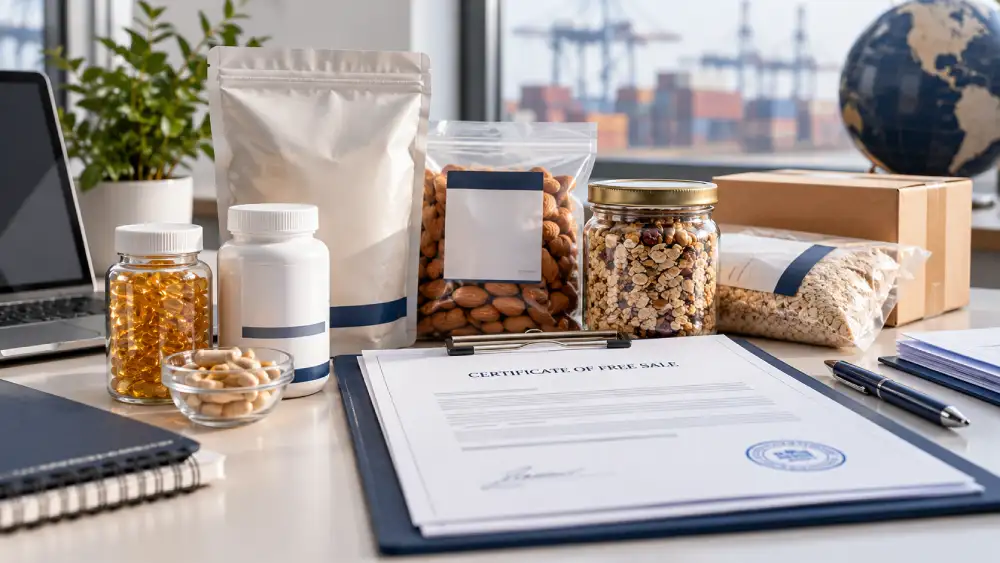
A Certificate of Free Sale for dietary supplements or food products is a document confirming that the products you are exporting are legally sold in the United States. Importing countries use it to approve product registrations, clear shipments and reassure their regulators that your product is not something made only for export. For most supplement and food companies, the CFS is one of the first documents a foreign distributor asks for.
If you are new to the document itself, start with our guide on what a Certificate of Free Sale is and why exporters need one. This post is for supplement brands, food manufacturers and private label companies that already know they need one and want to know what to prepare, what slows applications down, and how to get the certificate issued without a back-and-forth.
Why Foreign Markets Ask Supplement and Food Exporters for a CFS
Supplements and packaged foods sit in a gray zone for many regulators. They are not drugs, so they do not carry a full approval file, but they are swallowed, so health authorities want some proof that the product is legitimate. A CFS fills that gap. It tells the importing country that the product is already on the market in the US under US rules.
This matters most in markets that require product registration before the first shipment. In those countries, your distributor usually submits the CFS as part of a registration dossier, together with the label, the formula and sometimes a GMP certificate. Without it, the registration does not move.
Dietary supplements carry an extra layer of scrutiny. In the US, supplements do not need FDA approval before they are sold, and the manufacturer is responsible for safety and labeling. Foreign regulators know this, so a CFS is often the main official document they can rely on.
Which Products Need This CFS (and Which Do Not)
A chamber-issued CFS from WTC Northern California commonly covers:
- Dietary supplements in any form: capsules, tablets, powders, gummies, liquids
- Protein powders, sports nutrition and meal replacement products
- Herbal and botanical products sold as supplements
- Packaged foods, snacks, sauces, condiments and baked goods
- Beverages, teas, coffee and drink mixes
- Specialty and natural food products, including many California-made products
Some food categories follow their own federal export certification process instead. Meat, poultry and egg products are certified for export by the USDA Food Safety and Inspection Service. Fresh produce, plants and some agricultural commodities usually need a phytosanitary certificate from USDA APHIS. If your product falls in one of these groups, check with your buyer which document their customs office expects before you apply for a CFS.
The FDA also issues its own Certificate of Free Sale for dietary supplements, and some markets insist on an FDA-issued certificate for certain categories. Our post comparing the FDA and chamber of commerce Certificate of Free Sale explains which issuer each type of market tends to accept. When in doubt, ask your importer to confirm in writing which issuer their regulator wants.
What to Have in Place Before You Apply
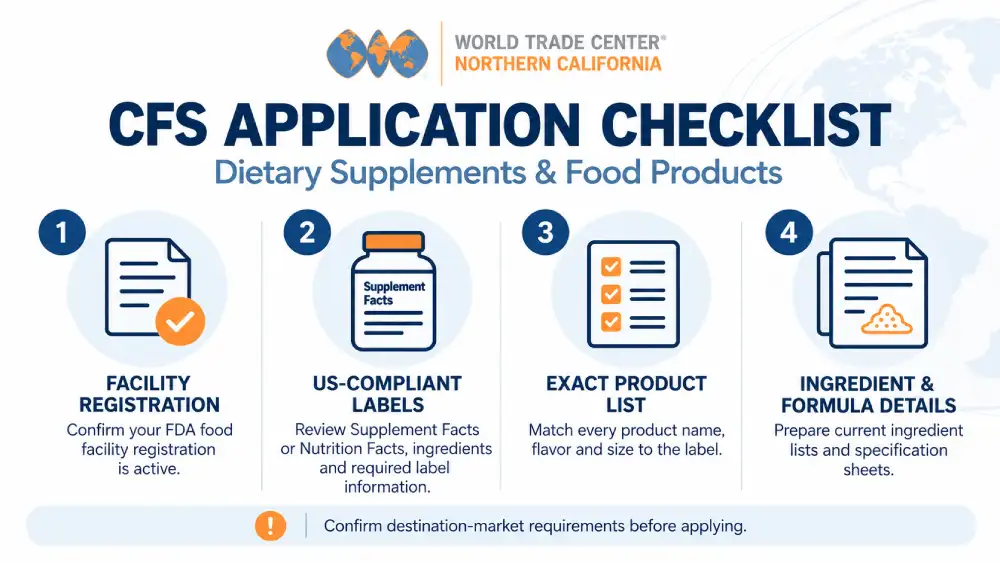
Most delays in supplement and food CFS applications have nothing to do with the certificate. They come from gaps in the exporter’s own paperwork. Check these four items first.
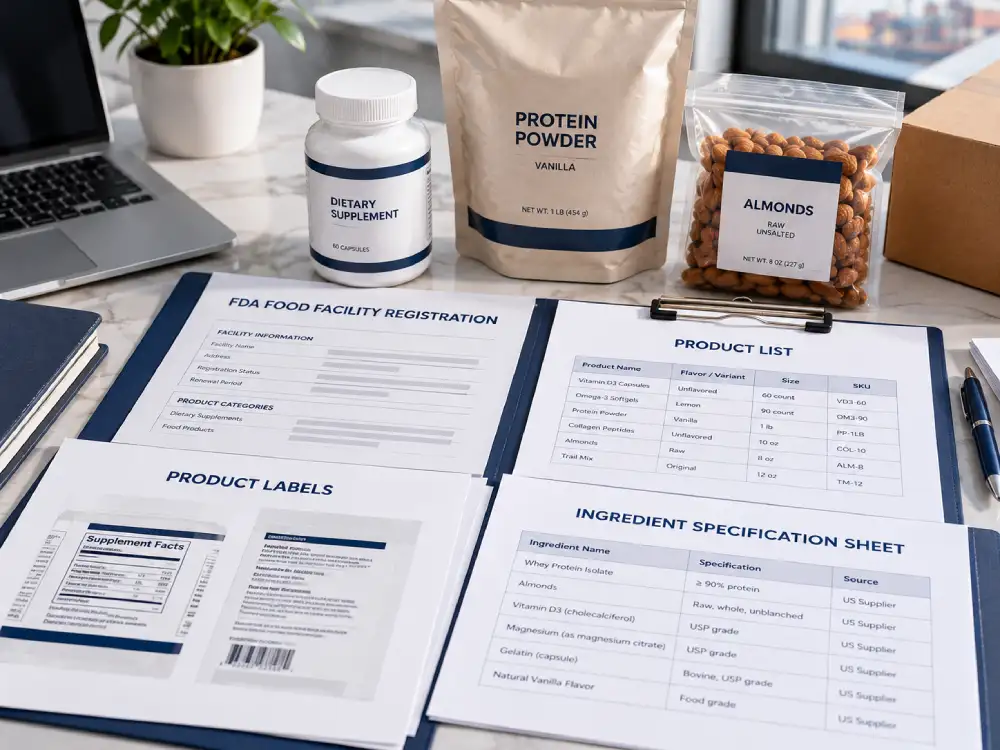
1. An active FDA food facility registration
Facilities that manufacture, process, pack or hold food for consumption in the US must register with the FDA, and dietary supplements count as food for this purpose. Under 21 CFR 1.230, registrations must be renewed every other year, between October 1 and December 31 of each even-numbered year.
That makes the end of 2026 a renewal window. If your registration lapses, any document that relies on it, including a CFS application that lists your facility, is harder to support. If you use a contract manufacturer, ask them for their current registration number and confirm it was renewed.
2. US-compliant labels
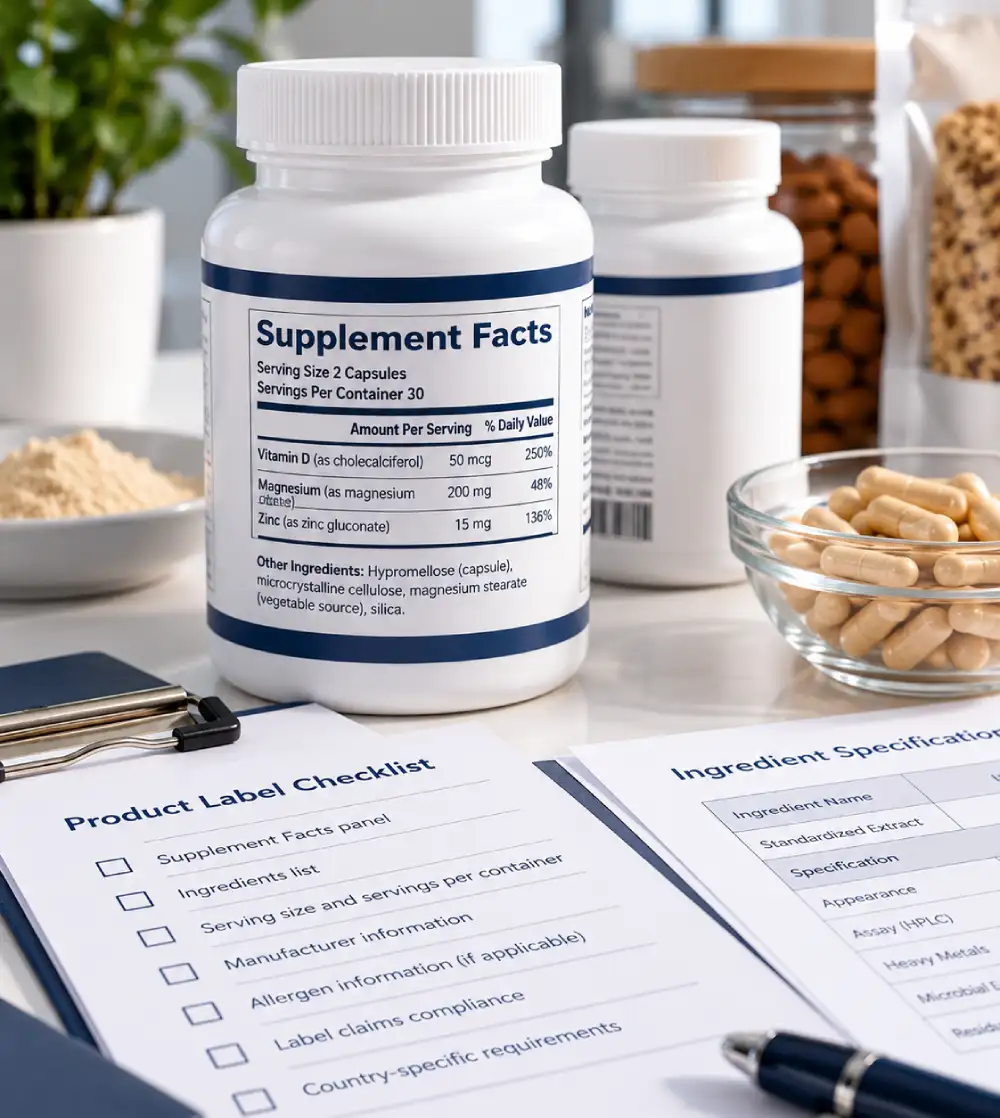
The CFS states that the product is sold legally in the US, so the label you submit has to look like a product that is. For supplements, that means a Supplement Facts panel, a statement of identity that includes the words “dietary supplement” (or a term like “herbal supplement”), net quantity, the manufacturer or distributor’s name and address, and the required FDA disclaimer for any structure or function claim. For conventional foods, it means a Nutrition Facts panel, an ingredient list and allergen labeling.
Labels with disease claims (“treats arthritis,” “prevents colds”) are a red flag. A product making drug claims is not lawfully sold as a supplement, and no issuer should certify it as freely sold.
3. A precise product list
The certificate lists each product by name. Use the exact names printed on your labels, including flavors and sizes when they are sold as separate products. “Whey Protein, Chocolate, 2 lb” and “Whey Protein, Vanilla, 2 lb” are two lines, not one. Mismatches between the certificate and the label are among the most common reasons a foreign registration office sends documents back.
4. Ingredient and formula details
Some markets want the formula or ingredient list attached to the registration dossier, and some issuers ask to see it. Have a current specification sheet ready for each product. If a product contains an ingredient that is restricted in your target country (certain botanicals, high-dose vitamins, some sweeteners or colors), find out before you ship. A CFS confirms US status. It does not make a product legal in a country that bans one of its ingredients.
GMP Certificates and the CFS: When Buyers Ask for Both
Many distributors of supplements ask for a GMP certificate together with the CFS. The two documents answer different questions. The CFS says the product is legally sold in the US. The GMP certificate says it was made under good manufacturing practices.
For supplements, the relevant FDA rule is 21 CFR Part 111, which applies to anyone who manufactures, packages, labels or holds a dietary supplement. Conventional foods fall under 21 CFR Part 117, the current good manufacturing practice and preventive controls rule for human food. Make sure the GMP evidence you send matches the product category. Our guide to GMP standards in the food industry covers the food side in more detail, and our GMP certificate for export page explains how WTC Northern California issues one.
How to Get a Certificate of Free Sale for Supplements or Food, Step by Step
Step 1: Confirm what the importing country wants
Ask your distributor three questions: which issuer is accepted (chamber or FDA), whether the certificate needs an apostille or consular legalization, and whether they need one certificate per product or one certificate listing several. Get the answers in writing. This step alone prevents most reissues.
Step 2: Gather your documents
Collect the product list, label files, your FDA facility registration number (or your manufacturer’s), and any specification sheets the market requires. If a contract manufacturer makes the product, include their name and address as it should appear on the certificate.
Step 3: Apply online
WTC Northern California processes Certificates of Free Sale online through the Swiftdox platform. You create an account, upload your documents and submit the application. Our trade specialists review it for compliance before the certificate is issued, which catches label and product name mismatches before they reach a foreign regulator.
Step 4: Receive and check the certificate
Certificates are delivered digitally. Before you forward it, compare every product name on the certificate with your labels and with the list your distributor submitted for registration. A one-word difference can stop a registration.
Step 5: Legalize it if the market requires
Some countries accept the certificate as issued. Others require an apostille or embassy legalization on top. If you are not sure which applies, see our guide on apostille vs. legalization. WTC Northern California can also handle apostille and legalization requests.
Common Reasons Supplement and Food CFS Applications Get Delayed
The same issues show up again and again.
Product names that do not match the label. The registration office compares the certificate to the label line by line.
Labels with drug claims. Claims that a product treats, cures or prevents a disease put its legal status in doubt.
A lapsed facility registration. Especially common at the end of even-numbered years when renewals are due.
The wrong issuer for the market. Some regulators accept only an FDA-issued certificate for certain products. Confirm before you apply.
Skipping legalization. A certificate without the required apostille or embassy stamp is treated as incomplete.
Ingredients that are restricted abroad. The certificate cannot fix a formula problem in the destination market.
Get Your Certificate of Free Sale from WTC Northern California
WTC Northern California issues Certificates of Free Sale for dietary supplements, food products, cosmetics and other consumer goods. Applications are submitted online, reviewed by our trade specialists and delivered digitally. Our Certificate of Free Sale fee is $110.
See all of our export documentation services or contact our trade specialists if you are not sure which certificates your market requires. If you sell cosmetics or personal care products too, our guide to the Certificate of Free Sale for cosmetics covers what changes for that category.
Frequently Asked Questions
Do dietary supplements need a Certificate of Free Sale to export?
Not always, but many importing countries require one before they register or clear a supplement. Your distributor or the destination country’s health authority can confirm whether it is needed for your product.
Can a chamber of commerce issue a Certificate of Free Sale for supplements?
Yes. Chambers of commerce and accredited trade organizations such as WTC Northern California issue Certificates of Free Sale for dietary supplements, and many markets accept them. Some regulators require an FDA-issued document for certain categories, so confirm with your importer first.
Do I need FDA approval to get a Certificate of Free Sale for a supplement?
No. Dietary supplements do not need FDA approval before they are sold in the US. You do need a lawfully marketed product, which includes compliant labeling and, for the facility, an active FDA food facility registration.
Can one Certificate of Free Sale cover several food products?
Often, yes. A single certificate can list several products, as long as each one is named exactly as it appears on its label. Some markets prefer one certificate per product, so check with your distributor.
How long is a Certificate of Free Sale valid?
Validity is set by the importing country, not by the issuer. Some regulators only accept certificates issued within a recent window, so check the requirement for each market before you ship.
Is a GMP certificate the same as a Certificate of Free Sale?
No. A CFS confirms the product is legally sold in the US. A GMP certificate confirms it was made under good manufacturing practices. Many supplement buyers ask for both.