
Incoterms 2020 Explained for Small Business Exporters
Key Takeaways
- Incoterms are 11 standard trade terms published by the International Chamber of Commerce (ICC). Each one says who pays for each part of the shipment, who handles customs, and where the risk of loss passes from seller to buyer.
- Seven rules work for any mode of transport. Four (FAS, FOB, CFR and CIF) are meant only for sea and inland waterway shipments.
- For most first-time US exporters, FCA is a safer starting point than EXW, and CPT or CIP fit container and air freight better than FOB or CIF.
- Incoterms do not decide your US export filing duties. The Foreign Trade Regulations state that terms of sale have no regulatory basis for export reporting.
Incoterms 2020 are the current edition of the International Chamber of Commerce’s rules for international sales. Each rule is a three-letter code, like FOB or DAP, that tells the buyer and seller exactly who arranges and pays for transport, who clears customs, who buys insurance, and the point where risk moves from one to the other. You write the code, a named place and the edition on your quote and invoice, for example “FCA Sacramento, Incoterms 2020,” and both sides know where their responsibility ends.
For a small business making its first export sale, the choice of Incoterm affects your price, your cash flow and your exposure if something goes wrong in transit. This guide explains all 11 rules in plain terms, shows which ones tend to suit new exporters, and covers the mistakes that cause the most disputes.
What Incoterms Cover (and What They Do Not)
According to the International Trade Administration, each Incoterms rule sets out which party handles carriage, export and import clearance, insurance, packing, pre-shipment inspection costs and delivery, and when risk of loss passes from seller to buyer.
The same source is just as clear about the limits. Incoterms do not set the price or the payment method, do not say when ownership of the goods passes, do not list which documents the seller must provide for customs clearance in the buyer’s country, and do not cover remedies for breach of contract or how disputes are resolved. Those points belong in your sales contract.
That distinction trips up many new exporters. An Incoterm tells you who pays for freight. It does not tell you when you get paid.
The 11 Incoterms 2020 Rules at a Glance
The ICC splits the rules into two groups: seven for any mode of transport, and four for sea and inland waterway transport only.
| Rule | Full name | Transport | Seller delivers when | Who pays main freight |
|---|---|---|---|---|
| EXW | Ex Works | Any mode | Goods are made available at the seller’s premises. | Buyer |
| FCA | Free Carrier | Any mode | Goods are handed to the buyer’s carrier at a named place. | Buyer |
| CPT | Carriage Paid To | Any mode | Goods are handed to the first carrier. | Seller |
| CIP | Carriage and Insurance Paid To | Any mode | Goods are handed to the first carrier. | Seller (plus insurance) |
| DAP | Delivered at Place | Any mode | Goods arrive at the named destination, ready to unload. | Seller |
| DPU | Delivered at Place Unloaded | Any mode | Goods are unloaded at the named destination. | Seller |
| DDP | Delivered Duty Paid | Any mode | Goods arrive at destination, cleared for import. | Seller (plus import duties) |
| FAS | Free Alongside Ship | Sea / inland waterway only | Goods are placed alongside the vessel at the port of loading. | Buyer |
| FOB | Free on Board | Sea / inland waterway only | Goods are loaded on board the vessel at the port of loading. | Buyer |
| CFR | Cost and Freight | Sea / inland waterway only | Goods are loaded on board at the port of loading. | Seller |
| CIF | Cost, Insurance and Freight | Sea / inland waterway only | Goods are loaded on board at the port of loading. | Seller (plus insurance) |
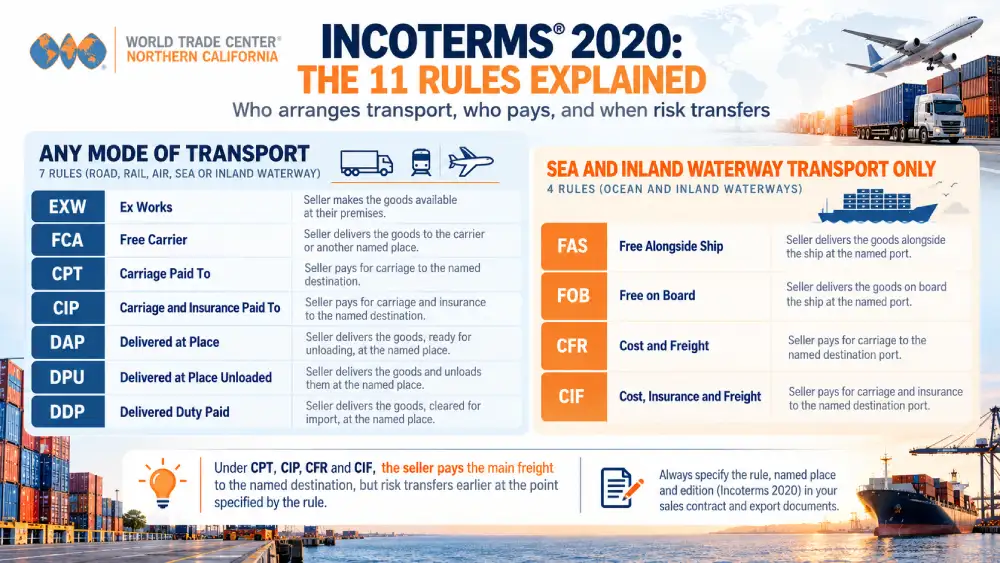
Under every rule except EXW, the seller handles export clearance. Under every rule except DDP, the buyer handles import clearance and pays import duties.
The Detail Most People Miss: Cost and Risk Split at Different Points
With the “C” rules (CPT, CIP, CFR and CIF), the seller pays freight all the way to the destination, but the risk passes to the buyer much earlier, when the goods are handed to the first carrier or loaded on board at origin. If a container is damaged at sea under CIF, the loss is the buyer’s, even though the seller paid for the voyage.
This is why insurance matters under the C rules. Incoterms 2020 sets different minimum coverage for the two rules that include it. According to the ICC, CIF keeps Institute Cargo Clauses (C) as the default, a more limited level of cover, while CIP now requires cover compliant with Institute Cargo Clauses (A), which is broader. If your buyer needs more protection under CIF, agree on it in writing.
With the “D” rules (DAP, DPU and DDP), cost and risk travel together to the destination. The seller carries both until the goods arrive.
What Changed in Incoterms 2020
If you last looked at Incoterms in 2010, the ICC summary lists these changes:
- DAT was renamed DPU (Delivered at Place Unloaded), and the destination no longer has to be a terminal.
- FCA now allows an on-board bill of lading. Buyer and seller can agree that the buyer’s carrier issues an on-board bill of lading to the seller, which matters when payment runs through a letter of credit.
- CIP requires a higher level of insurance, as described above.
- All costs are listed in one place in each rule (articles A9 and B9).
- Security-related obligations are spelled out more clearly.
- Parties can use their own transport under FCA, DAP, DPU and DDP, instead of always relying on a third-party carrier.
Older editions are still valid if both parties agree. Trade.gov notes that contracts can reference Incoterms 2010 or an earlier version, as long as the edition is clearly stated. Always write the edition next to the code.
Which Incoterms Make Sense for a New US Exporter?
There is no single right answer. It depends on your buyer, your product and how much logistics work you want to take on. These patterns hold for most small exporters.
Think twice before quoting EXW
EXW looks like the easiest option: the buyer picks up the goods at your door and handles everything else. In practice, it creates problems for US sellers. Under EXW the buyer is responsible for export clearance, but the US Foreign Trade Regulations do not care about the term of sale. 15 CFR 30.3 states that international commercial terms “have no regulatory basis” for determining the parties to an export transaction. As the US seller, you can still have reporting and recordkeeping duties, and you depend on a foreign buyer’s agent to get the filing right.
EXW also makes the buyer responsible for loading at your premises, which rarely matches reality. Your staff usually loads the truck anyway.
FCA is often the better “buyer arranges freight” option
FCA keeps most of what makes EXW attractive. The buyer still chooses and pays the main carrier. But you handle export clearance, so you stay in control of the information filed with the US government. If delivery is at your facility, you load the goods. If it is at a forwarder’s warehouse or a terminal, you deliver them there.
Use CPT or CIP instead of CFR or CIF for containers and air
FOB, CFR and CIF were written for goods loaded directly onto a ship. Most small exporters ship in containers or by air, which means the goods are handed to the carrier at a warehouse or terminal days before the ship sails. Under FOB, you would still carry the risk during that gap. FCA, CPT and CIP match how container and air freight actually moves, so risk passes when you hand the goods over.
Be careful with DDP
DDP is the most buyer-friendly rule, and some e-commerce customers expect it. It also puts you in charge of import clearance, duties and taxes in a country you may not know, and some countries make it hard for a foreign seller to act as importer. Unless you have a partner on the ground who can handle that, DAP is usually the safer delivered option.
A quick example
A Sacramento food producer sells its first pallet of packaged goods to a distributor in Japan, shipped by ocean container. The distributor has its own forwarder. The producer quotes FCA (forwarder’s warehouse, Oakland), Incoterms 2020. The producer clears the goods for export and delivers them to the forwarder. From that point, freight, risk and import clearance belong to the distributor. If the same buyer wanted a delivered price instead, CIP Yokohama, Incoterms 2020 would let the producer pay freight and insurance to Japan, with risk passing in Oakland.
Common Incoterms Mistakes Exporters Make
Leaving out the named place. “FOB” alone means little. “FOB Port of Oakland, Incoterms 2020” means something specific. The more precise the place, the fewer the arguments.
Not stating the edition. Write “Incoterms 2020” every time, or the parties may be reading different rules.
Using sea-only rules for container or air freight. FOB on an air shipment is a common error, and it leaves the risk point unclear.
Confusing US domestic shipping terms with Incoterms. In US domestic trade, “FOB shipping point” and “FOB destination” are common and work differently. Internationally, use the Incoterms version and name the edition.
Assuming the Incoterm covers payment. It does not. Payment terms (advance payment, letter of credit, open account) go in the contract.
Assuming the buyer’s Incoterm handles your compliance. Your obligations under US export regulations do not change with the term of sale.
Where Your Incoterm Appears on Export Documents
Put the same Incoterm, named place and edition on your quote, pro forma invoice, sales contract and commercial invoice. The commercial invoice is the document customs officers check first, and our overview of what documents you need to export from California explains what else it should include.
Your Incoterm also connects to other paperwork. The term decides who arranges the Certificate of Origin, the Certificate of Free Sale or any legalization the destination country asks for, so settle it before you start on documents. If your goods qualify under a US free trade agreement, see our guide on how to determine the country of origin for your export product, and make sure the classification on every document matches by following our guide on how to find the HS code for your export product.
Get Export-Ready with WTC Northern California
Choosing the right Incoterm is one part of quoting an export sale well. WTC Northern California helps small businesses with the rest: our no-cost, 10-week World Trade Connect Accelerator Program covers international pricing, payments, logistics and compliance for California small businesses, and our free export training programs post lists more resources.
When your shipment is ready, we issue the export documents your buyer asks for. Get your Certificate of Origin online or see all of our export documentation services.
Frequently Asked Questions
What are Incoterms 2020?
Incoterms 2020 are 11 standard trade rules published by the International Chamber of Commerce. Each rule defines who pays for transport, insurance and customs clearance in an international sale, and where the risk of loss passes from seller to buyer.
What is the best Incoterm for a new exporter?
For many first-time US exporters, FCA is a good starting point, because the buyer arranges the main freight while the seller keeps control of export clearance. If you want to quote a delivered price, CPT, CIP or DAP are common choices.
What is the difference between FOB and CIF?
Under FOB, the buyer pays the ocean freight and arranges any insurance, and risk passes when the goods are loaded on the ship. Under CIF, the seller pays freight and minimum insurance to the destination port, but risk still passes when the goods are loaded at origin.
Can I use FOB for air freight?
It is not recommended. FOB, FAS, CFR and CIF are designed for sea and inland waterway transport. For air freight, use rules for any mode, such as FCA, CPT or CIP.
Are Incoterms legally binding?
Incoterms become binding when the parties include them in their sales contract. They are not a law on their own, and they work best when the contract names the rule, the place and the edition.
Can I still use Incoterms 2010?
Yes, if both parties agree and the edition is clearly stated in the contract and documents. The ITA notes that any edition can be used as long as it is identified.